top of page
Acrylic Mixing of Colors
You will be using only red, yellow, and blue to create all other colors. These three colors are called primary colors and cannot be mixed (must be bought).
Step 1: Prep your board to look like mine. You may use a marker or pencil (or whatever, it doesn't matter as long as it makes a mark). Label like mine as well.
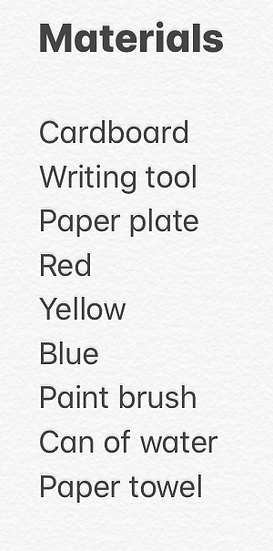

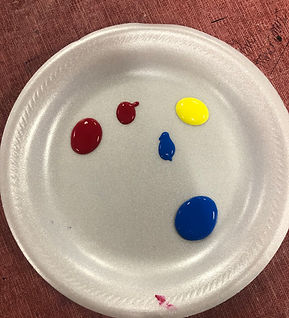
Step 2: Prep your pallet. Meaning: get paint on your paper plate! You do not need a ton, you can always get more but pouring access back is very difficult. You will be mixing directly on your plate.
Step 3: Paint in your primary sections (unmixed). You may need to paint, let dry, then coat again if needed.

Step 4: Now you will be mixing two colors at a time. Lets start with yellow and blue to make a variety of greens. Green is a secondary color, meaning it is created by mixing two primary colors. When mixing two acrylic colors ALWAYS take a dab of the lightest color, in this case that will be yellow. Then, you will be mixing small amounts of blue into the yellow to create different varieties of greens, you will go from light green to forest green. If you must get more paint you may. Please be conservative with paint. Once you mix the lightest green paint the section in between the yellow and the blue that is closest to the yellow section. Any colors on your color wheel that are in between the secondary and primary colors are called intermediate colors or tertiary colors.
Next, you will add more blue until the color changes to a green, paint the green section, add more blue to the mix until you have a nice blue-green and paint in the section that is between yellow and blue but closest to blue.

Step 5: repeat step four except you will be using red and yellow this time. Start with yellow, add bits of red until you have created all the orange varieties.

Step 6: repeat step four except you will be using red and blue this time. Start with blue (technically red is the darkest primary color), add bits of red until you have created all the violet varieties.

Step 7: Now see if you can make brown, brown is simply all primaries mixed. To take a shortcut, green = yellow + blue. If you mix red and green (opposites on the color wheel) you should get blue. If your brown is too red tinted you need more green and vice versus.
You are finished! NOW you should keep in mind that you can darken or lighten any color to create different shades of that color. For instance you can mix red and white to create pink, red and black to create maroon. Follow the same "rules" when mixing with black and white, always start with the lightest and add the darker color a little at a time until you achieve the color you are looking for. You can mix any color imaginable simply by using 5 paint colors: primaries and black and white.
Do not forget to publish your artwork to artsonia under the name "acrylic color wheel".
bottom of page